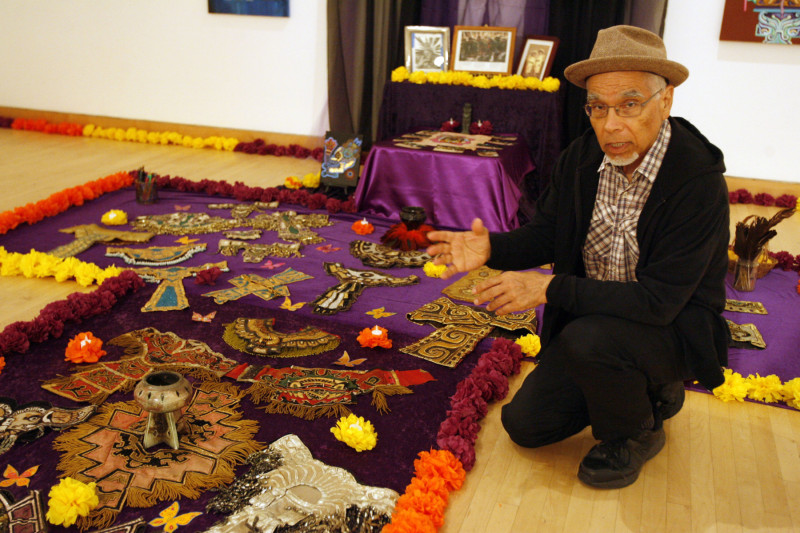
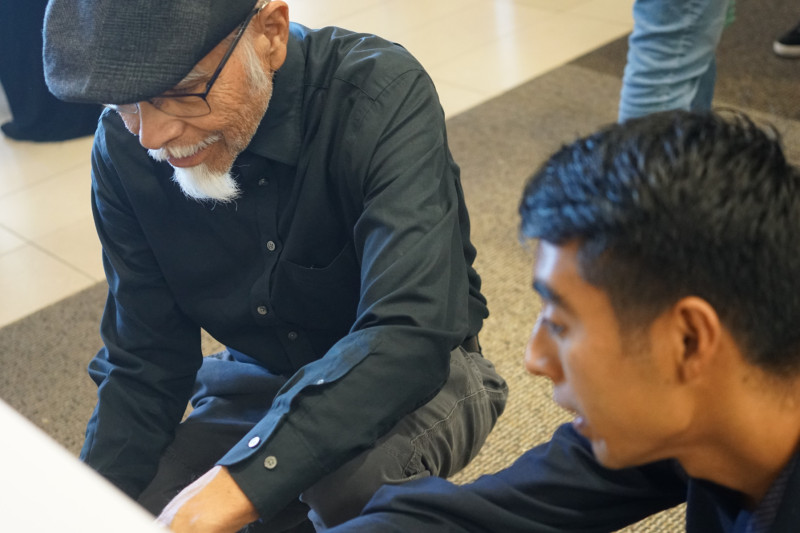
In Memoriam: David Avalos, 1947-2025
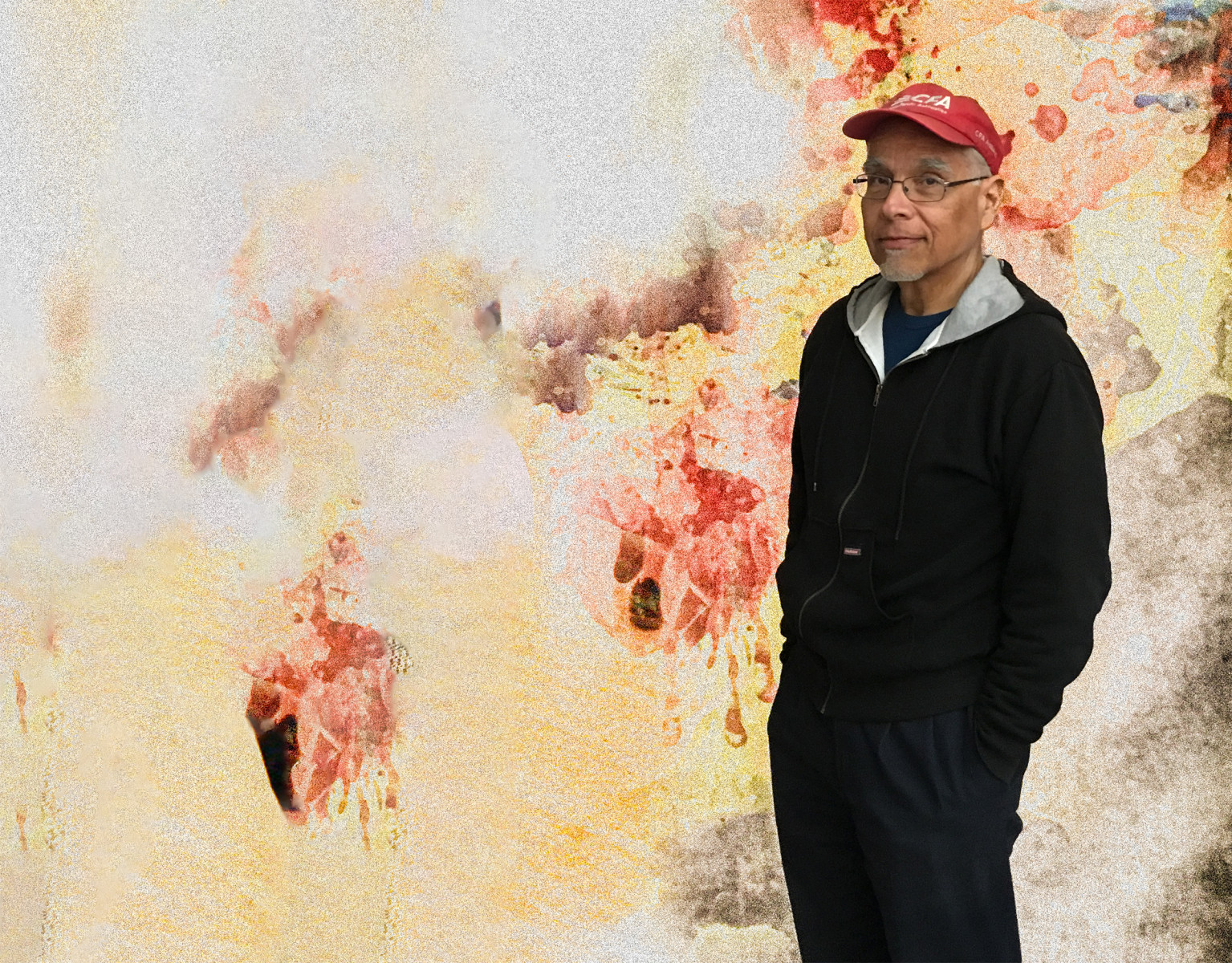
The Cal State San Marcos community celebrates the life and work of the indelible David Avalos, Eternal Emeritus Professor of Art. Eternal is added to his title due to his core contributions as a founding faculty member at CSUSM, champion and steward of the arts program, and the ongoing impact of his work, words and deeds on the campus community and on the region – a community that he prodded ever to be our best selves, our most critical, creative and brave selves.
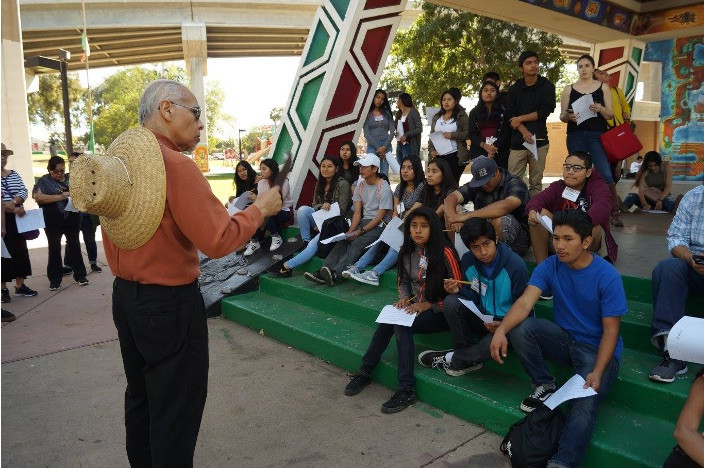
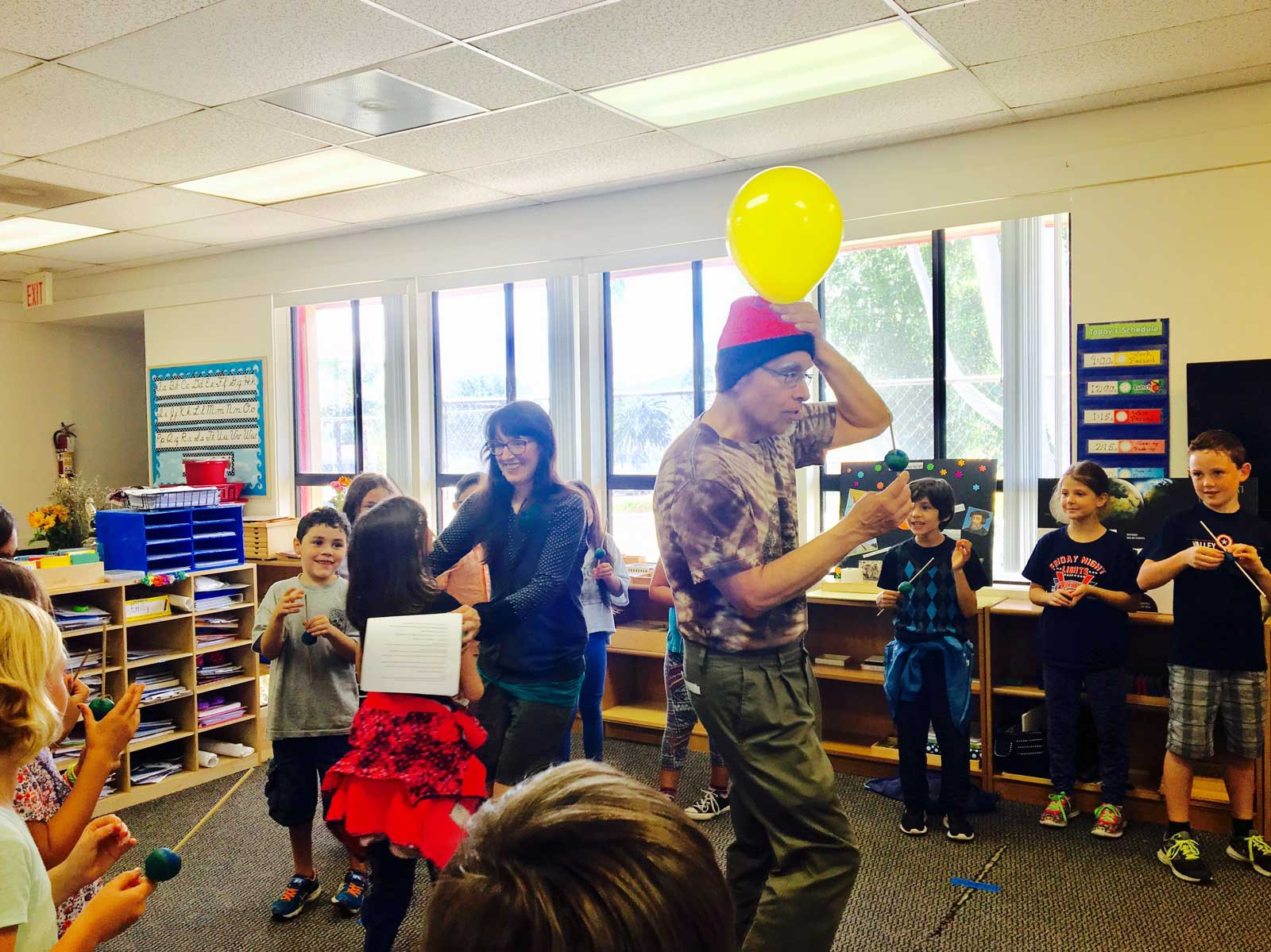
Avalos joined CSUSM in 1991 and was active under the umbrella of emeritus professor as artistic mentor and union advocate until his passing. He was often the first person whom new faculty engaged with on campus, initiating conversations that drew out ideas and created connections with fellow faculty; and he held our campus memory, reminding newcomers of the university’s foundation on radical interdisciplinarity. Campuswide, Avalos was known for his strolls with colleagues, his signature synthesis of ruminating walks and talks while making salient connections across ideas and with passersby from all areas of campus. He introduced generations of faculty and students to the murals in Chicano Park and served as faculty adviser to the Danza Azteca and Ballet Folklorico student groups on campus. Avalos was a mentor and collaborator to his colleagues in the arts; he contributed last year with an oral history about the border for the artwork of Cognate Collective, the collective composed of Misael Diaz and Amy Sanchez Arteaga, and collaborated with Lucy HG Solomon and CSUSM students on a performative study of the equinox, presented at grade schools in 2017.
Avalos gained a national and worldwide reputation for his multimedia and avant-garde art that focuses on border and labor-related issues, often advocating for the rights of Mexican immigrants, raising concerns over police brutality, and protesting a racist anti-immigration movement that burgeoned dramatically in the 1990s. Many of his works are in permanent collections, including those of the Museum of Contemporary Art San Diego and the Smithsonian American Art Museum. He made a political statement with the artwork “Donkey Cart Altar” (1985) when he placed it in front of the San Diego federal courthouse to protest that immigrant laborers working to feed their families were being treated as criminals. Judge Gordon Thompson Jr. ordered the work, which he deemed a “security risk,” to be removed, with the ACLU rallying to defend Avalos’ freedom of expression in a court filing against the judge – a filing that was ultimately dismissed. Avalos petitioned to the Supreme Court in David Avalos and Sushi, INC. vs. Gordon Thomposn, Jr., et al. While the Supreme Court did not take up the case, it garnered national attention.
Beginning in 1988, Avalos worked alongside artists Louis Hock and Elizabeth Sisco, and he also collaborated with Deborah Small (CSUSM professor emerita) and James Luna, developing artworks that addressed the complex issues of immigrant labor, border politics and multiculturalism in California. “Welcome to America’s Finest Tourist Plantation” (1988) – designed by Avalos, Hock and Sisco as a rear advertising panel and placed on nearly half of the city’s local buses – taunted San Diegans leading up to the Super Bowl, held in January that year. Publicizing the plight of undocumented workers, the artists turned the artwork into a major media event, asserting art’s right for free expression. Avalos became known for his conviction that artists have the responsibility to interact with their environment and community. “Art Rebate/Arte Reembolso” (1993) by Avalos, Hock and Sisco, a public art project that involved distributing $10 bills to undocumented workers in San Diego, aimed to challenge the perception that undocumented workers negatively impact the economy by highlighting their contributions and providing an art rebate in leu of the tax rebate that the workers could not claim, despite paying taxes and into Social Security. Commissioned by the Museum of Contemporary Art San Diego and Centro Cultural de la Raza, the project sparked debate and criticism in local and national media and in Congress.
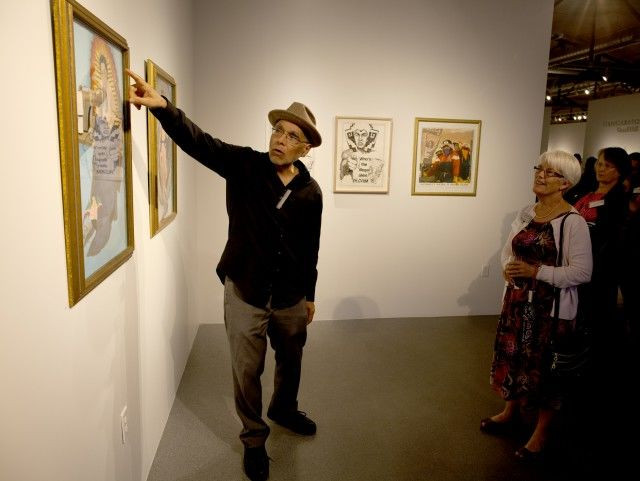
A descendant of one of the oldest families in National City (his mother’s family arrived in the 1910s and his father’s family arrived in the '20s), Avalos was an instigator of creative ideas whose art and activism became a fixture within National City’s rich community of Chicano/a artists, activists, scholars and educators. He attributed his rise in political consciousness to his upbringing: “… I think that that consciousness came only with my involvement with the civil rights organization in my hometown, National City, the Committee on Chicano Rights” (Smithsonian oral history interview with Avalos, 1988). A Vietnam-era U.S. Army veteran stationed in West Germany in the late 1960s, he connected with veteran students and he valued the education that the G.I. Bill afforded him, at San Diego State and later at UC San Diego, where he contributed illustrations to a student newspaper called Voz Fronteriza. He worked at the Chicano Federation and in 1978 he began working at the Centro Cultural de la Raza and with the Committee on Chicano Rights. At the Centro Cultural de la Raza, he worked with multidisciplinary artists throughout the 1980s, and with Victor Ochoa and Michael Schnorr (plus the collaborative entities Cinewest Productions and Poyesis Genética), he co-founded the Border Art Workshop/Taller de Arte Fronterizo, which he described as “a collective focused on the dynamic balance of U.S.-Mexico absurdities.” Avalos’ art provocations and teachings will long be remembered by students and colleagues alike.
An active member of the National Latino Research Center advisory board as well as a faculty associate of the center and longtime California Faculty Association chapter rights representative, Avalos stood in solidarity with the NRLC and CFA throughout his career and was a vital mentor and colleague, providing invaluable guidance and inspiration to generations of faculty, staff and students. The School of Arts, NLRC, CSUSM’s CFA chapter and Center ARTES collectively remain committed to continuing the legacy of Avalos both on campus and in the community. A committed thinker, he never stopped learning, always probing others about their understanding of the world. Prescient in his artmaking about contemporary politics, Avalos continues to move new generations of thinkers and creators with his percussive art and legacy of activism.
Avalos is survived by his wife, Veronica Enrique Avalos, their four children (Xima, Tona, Graciano and Adrian) and grandson, Leon, and in the campus community, his cousin Fredi Avalos. In May of this academic year, the School of Arts will commemorate David Avalos as artist, thinker, professor and provocateur, with an opportunity to share reflections on his impact on the community and on the arts in the border region and beyond. Further communication about this opportunity to celebrate Avalos and his lasting impact at CSUSM will be shared across the campus community.
To hear Avalos in his own words across the years, you are invited to follow the links below:
Interviews in Califas: Chicano Art and Culture in California (1983)
David Avalos on his work Loteria Chicana “La Placa” (1983)
Oral History with David Avalos, Smithsonian Archives of American Art (1988)
David Avalos on Chicana/o Art (2007)
Charla with the Museum of Contemporary Art San Diego (2021)
David Avalos ¡Presente!