


UniHealth Foundation Invests $500K in Interprofessional Palliative Care Education
By Debby Clark
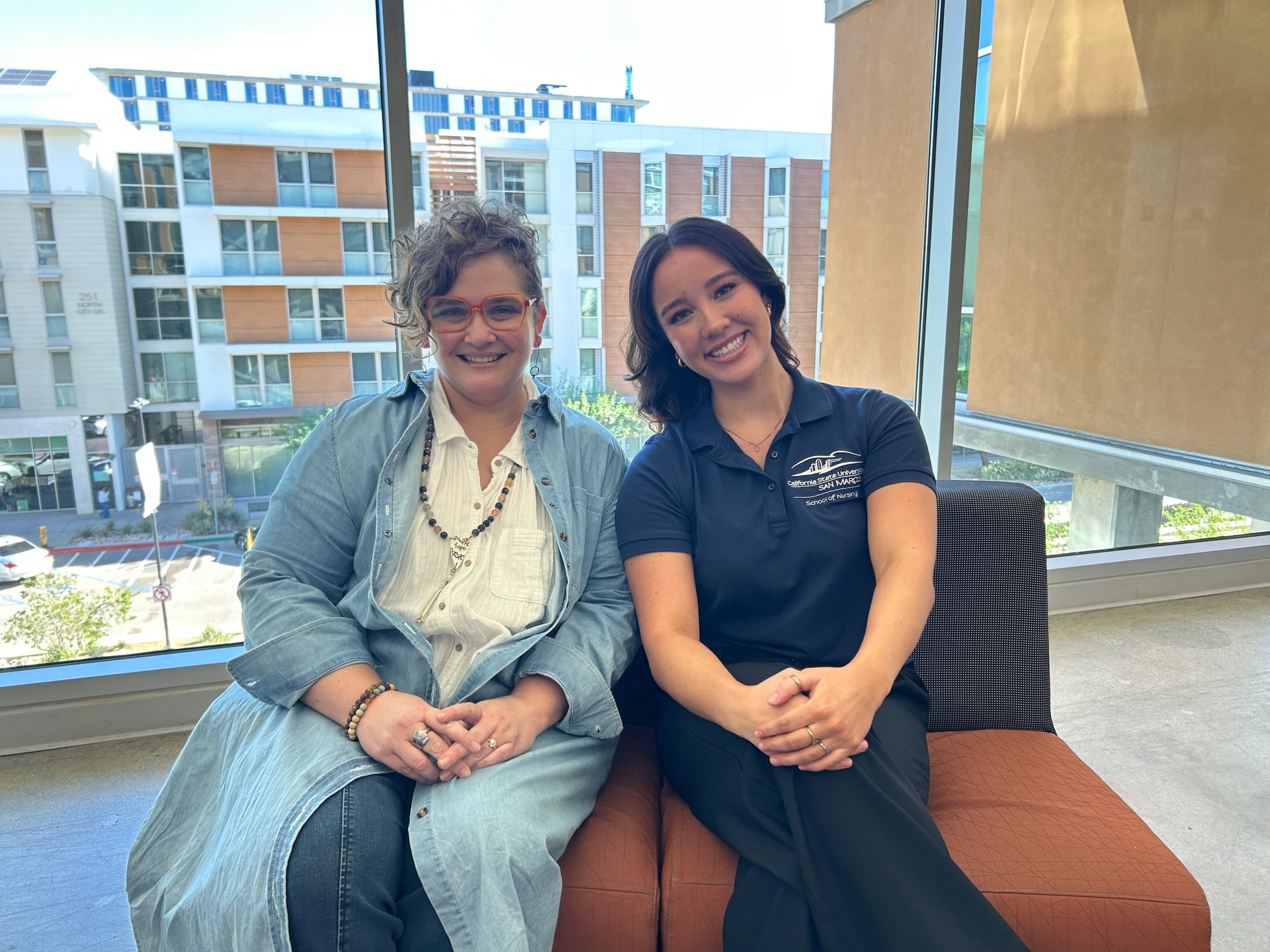
Long before becoming a nursing student at Cal State San Marcos, Mikoto Detwiler knew exactly what she wanted to do.
Inspired by her mother, who worked as a nurse in Japan and the United States, Detwiler spent much of her childhood playing with her mom’s scrubs, wearing her hospital badge and dressing as a nurse for Halloween three years in a row.
Now a fourth-year nursing student at CSUSM, Detwiler will graduate in May with a more nuanced understanding of health care.
One experience that helped shape that perspective was a daylong Interprofessional Education (IPE) simulation hosted by the CSU Shiley Haynes Institute for Palliative Care at CSUSM. There, Detwiler joined students from nursing, kinesiology, speech-language pathology and social work to analyze a case study and develop a comprehensive plan of care.
Designed to mirror real-world healthcare settings, the simulation challenged students to think collaboratively while gaining a better understanding of each profession’s role in patient care. The exercise is part of the institute’s broader mission to prepare the future healthcare workforce to support those impacted by serious illness.
“Patient- and family-centered care are big buzzwords in healthcare, but this experience helped me understand what that really means,” Detwiler said. “Patients and their families can easily feel overwhelmed by the amount of information they receive. Collaborating with other disciplines showed me how many resources and perspectives are available to help them feel informed, supported and overall more confident in their care.”
Thanks to a $500,000 grant from UniHealth Foundation, more students across the California State University system will soon have the same opportunity.
“CSUSM’s expansion of interprofessional education envisions a health system that is collaborative, well-staffed and firmly centered on quality care,” said Jennifer Vanore, Ph.D., president and chief operating officer of UniHealth Foundation. “We're proud to support the IPE program as it develops health professionals equipped to maintain quality of life for patients and their families across all communities.”
Initially developed and implemented at CSUSM in spring 2023, the IPE program has since grown into a systemwide initiative through the leadership of the CSU Shiley Haynes Institute for Palliative Care, an organization dedicated to advancing palliative care education across the CSU. The program expanded to Fresno State in 2025 and will now reach four additional CSU campuses: Sonoma State, Cal State Monterey Bay, San Jose State and Cal State Northridge.
Through a train-the-trainer approach, faculty from each institution will learn how to adapt the program to meet the unique needs of their students, academic programs and surrounding communities.
“We’re so thankful for this grant and to see what started at CSUSM bridge to other campuses,” said McKenzie Blake, associate director of educational programs at the CSU Shiley Haynes Institute for Palliative Care. “Not only are students benefiting, but faculty across campuses will have opportunities to collaborate, share best practices and pursue joint research, presentations and publications that can advance interprofessional education throughout California.”
For Katie Robinson, an associate professor of nursing and the director of IPE at the institute, one of the most exciting aspects of the initiative is seeing how a model originally developed for healthcare students can be adapted to other campus settings and other academic programs outside of specific healthcare-focused training programs.
The interprofessional simulation model was recently applied in CSUSM's College of Humanities, Arts, Behavioral and Social Sciences, where students from sociology, communication, medical anthropology and modern language studies participated in a collaborative, case-based learning experience.
“We have a model that is shown to be effective,” Robinson said. “Now we're seeing that it can be adapted not only by other universities, but also by disciplines beyond healthcare, including the arts and humanities. But ultimately, the greatest measure of success is seeing students recognize how these experiences will help them become better professionals and collaborators throughout their careers.”
For Detwiler, the lessons learned through interprofessional education will stay with her long after graduation.
“You can only learn so much in a classroom setting,” Detwiler said. “This experience gave me a hands-on understanding of each person’s perspective and how that’s rooted in their specialty. Seeing how different disciplines work together to support patients and families is something I'll carry with me long after I graduate.”
Media Contact
Brian Hiro, communications specialist
bhiro@csusm.edu | Office: 760-750-7306