


Time at CSUSM Helps Computer Science Grad Make Forbes' List
By Eric Breier

Parents usually do anything they can to get their kids to take a break from playing video games.
Emily Sorger’s parents took a different approach.
“When I was younger, my dad would say, ‘No, you can't go outside and play until you finish this level’ or ‘You can't do your homework until you play this game and tell me if you like it or not,’ ” Sorger said, laughing. “My mom and dad were kind of opposite the typical parents in that way. They were encouraging me to play a video game before I got to my other responsibilities.”
It’s a parenting approach that makes more sense when you realize that Sorger’s parents both worked in the video game industry. But Sorger didn’t just play video games as a child. She got an insider’s look at how they are created, and it sparked a desire from a young age to be part of that world.
It’s not that Sorger didn’t have other passions. A competitive snowboarder, she dreamed of Olympic glory as a teenager. But video game development was always a goal, one that solidified when she became a computer science student at Cal State San Marcos. Today, just six years after graduating, she has been recognized among the best in her industry.
Forbes magazine annually honors young innovators and leaders in 20 industries. Last December, Sorger flew to New York, where she was honored for making Forbes’ 2026 30 under 30 list in the “Games” category.
“Friends and family have been very excited about the Forbes accolade,” Sorger said. “I keep telling everybody that, sure, it’s partially my journey, but I definitely attribute a lot of it to all the mentors that I had at CSUSM and other places. It's just as much their journey as it is mine.”
For Sorger, that journey began in earnest during a high school robotics class. Her teacher knew she was interested in video game development and encouraged Sorger to attend CSUSM’s Women’s Hackathon, an annual event providing students from local high schools and colleges the opportunity to work in teams and propose technology solutions for nonprofit organizations. The event has supported hundreds of female students since its founding by computer science professor Youwen Ouyang more than a decade ago.
Sorger and her teammates created a bubble shooter game that promoted bone health.
“It sounds silly, but it was really fun and ended up winning the grand prize,” Sorger said.
Sorger’s abilities caught the attention of Ouyang, who started asking about her college plans and how CSUSM might be able to help her achieve her goals.
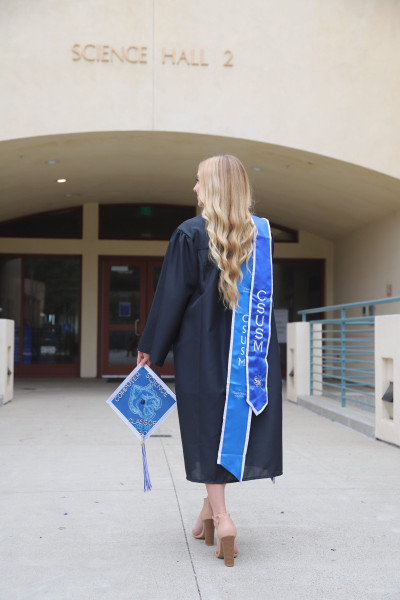

While Sorger’s familial connections to the video game industry sparked her curiosity about how they are created, she credits CSUSM for helping her develop the skills she needed to thrive. And as Sorger was honing those skills, she also was helping younger students hone theirs. At CSUSM, she mentored local high school girls through the Code Queens Club, which empowered participants and helped them pursue careers in computer science.
“I think there's maybe some stigma that it's really hard and maybe a little daunting to get into,” Sorger said. “When people hear about video game developers, they envision somebody sitting in a dark cave with just the glow of their computer screen. And it was fun to be able to break that stigma.
“I loved being able to mentor those girls. Some of them went into the computer science field, which was exciting, and others went into biology or other STEM fields. We tried to always teach and encourage them that no matter what field you're interested in, STEM can probably play a role in it.”
During her senior year at CSUSM, Sorger had the chance to work with computer science professor Yuanyuan Jiang on an independent study course focused on game development. Sorger designed and built a multilevel platformer game complete with a local leaderboard, giving her valuable hands-on development experience.
But Sorger faced a challenging job environment when she graduated in May 2020. Job offers, including one Sorger had received, were rescinded and many companies implemented hiring freezes in response to the pandemic.
Sorger never lost hope, though, and the initiative she showed throughout her time at CSUSM paid off. During her senior year, before the pandemic hit, she attended a women in STEM networking event hosted by mobile entertainment giant Jam City. A year later, one of the people Sorger met at the event called with a job opportunity as an associate producer.
Sorger spent her first 18 months at Jam City working on a home decoration game for the TV network HGTV before being promoted as the company’s first technical producer. The role, built around Sorger’s skillset, puts her in charge of a team of 50-plus developers on the game “Cookie Jam,” which still enjoys wide popularity more than a decade after its launch.
“I love that video games are a creative outlet,” Sorger said. “They're expressive. I get to build something that millions of people play throughout the years. That really drew me right to it. I meet a lot of people who assume that if you want to be in the video game space, you have to be an engineer. But you can come from any craft. We have amazing artists, tech artists, the effects people who do animations, you need story writers. You really need people from all walks of life.
“I always tell people that this is an amazing field and it's honestly so much fun. I love what I do and I love the people that I get to work with, so I always do my best to encourage people. That's why I loved my time at CSUSM. It played a major role in helping me discover how I could combine creativity, technology and leadership to build games that reach millions of players. I honestly could not have picked a better school.”

Media Contact
Eric Breier, Assistant Director of Editorial and External Affairs
ebreier@csusm.edu | Office: 760-750-7314