


Social Sciences Student Connects With American Indian Heritage
By Alicia Lores

Cheyenne Smith never felt like she fully belonged. As a biracial woman, she was trapped within an agonizing dilemma of feeling too white-passing to be entitled to her American Indian heritage. This paradox made navigating life as a college student, especially during a global pandemic, challenging.
As a transfer student from MiraCosta College, Smith’s arrival at Cal State San Marcos was a frightening one. She worried that she again would feel isolated in a new environment. But Smith not only found a place where she felt fully accepted, she found a new place to call home.
"Cheyenne exemplifies the spirit of community engagement and scholarly excellence that we hold dear at the California Indian Culture and Sovereignty Center (CICSC)," said Joely Proudfit, one of Smith's mentors and the director of the CICSC. "Throughout her time at CSUSM, she has profoundly impacted her peers, the campus and the broader community through her unwavering kindness, empathy and dedication to service.”
While much of Smith’s family identifies as white, her father is American Indian, having been adopted into a white family. It was with her father’s help that Smith learned to embrace her Lakota heritage and its traditions. But she always craved more.
After her parents divorced, Smith lived with her mother in Oceanside, losing some of the closeness she had with her father. Neither of her parents had earned a college degree – her father was in the military and her mother became pregnant with Smith while enrolled in college. However, this fueled Smith’s desire to become the first in her family to graduate from college and follow her passions.
“I think I just want to be an inspiration to them,” Smith said.
Smith spent most of her first two years of college quarantined due to the COVID-19 pandemic, giving her few opportunities to connect with her peers or other students like herself.
“I was trapped inside, there was nothing happening,” she said. “I felt like I was not progressing.”
That began to change after she transferred to CSUSM in 2022.
During her first year, Smith joined the American Indian Student Alliance (AISA), which turned into a life-changing experience as she discovered a sense of community, pride in her heritage and mentors like Proudfit, American Indian studies professor Eric Tippeconnic and CICSC program specialist Monica Zavala. For the first time, Smith felt like she belonged and was encouraged to embrace her identity.
“Through AISA, I saw not only people who presented strongly as Indigenous, but also people who looked similar to me and didn’t see themselves as less Indigenous,” Smith said.
Even with this new community, college life still proved to be challenging. Struggling with severe anxiety and depression during her second semester at CSUSM, Smith began to seclude herself and stopped attending classes. She spent most of that time tucked away in her bed, ignoring worried messages from professors, friends and mentors. She dreaded facing pressure from school and her personal life.
“I feel like I did have a lot of support during that time that I just wasn't willing to take,” she said. “I do regret not taking advantage of the support my friends and professors offered me. They were doing the best they could. They knew something was wrong with me because it was not like me to just disappear like that.”

Smith failed most of her classes that semester, but it was also a turning point that changed the course of her academic journey. Once more, Smith turned toward AISA and her support system.
Smith started attending classes again, elevated her academic standing and searched for opportunities to advance in her career path. During her search, a friend from AISA encouraged Smith to apply for a position in psychology professor Kim Pulvers’ research lab for a Tobacco, E-Cigarette and Cannabis Waste Randomized Control Trial (TECW RCT). Smith is grateful to Pulvers for looking past her grades from the previous semester and recognizing her potential.
The TECW RCT became a great opportunity for Smith to garner more experience working as a counselor and preparing to become a social worker. Smith also became involved in the CICSC, through which she has helped spread awareness of the benefits of American Indian student centers on college campuses. Even though there were some bumps in the road, Smith came back more determined than ever, inspired to help people like her in the same way that CSUSM, AISA and CICSC had helped her.
“I'm probably the most at peace I've ever been,” Smith said.
Smith is motivated by the words of Tippeconnic, one of her mentors, who told her, “A win for you is a win for the community.” For the next year, she will further her research at CSUSM, this time as a faculty member, before attending graduate school. She has her sights on eventually becoming a social worker for the Missing and Murdered Indigenous Women organization, helping American Indian women feel supported in their efforts to combat violence against Native people.
 “As she transitions from our halls to the broader stages of professional life and graduate studies, we are filled with pride and anticipation,” Proudfit said. “Cheyenne's commitment to serving both the American Indian community and society at large promises to forge paths of positive change and enduring impact. We are excited to see the remarkable contributions she will undoubtedly make in her future endeavors.”
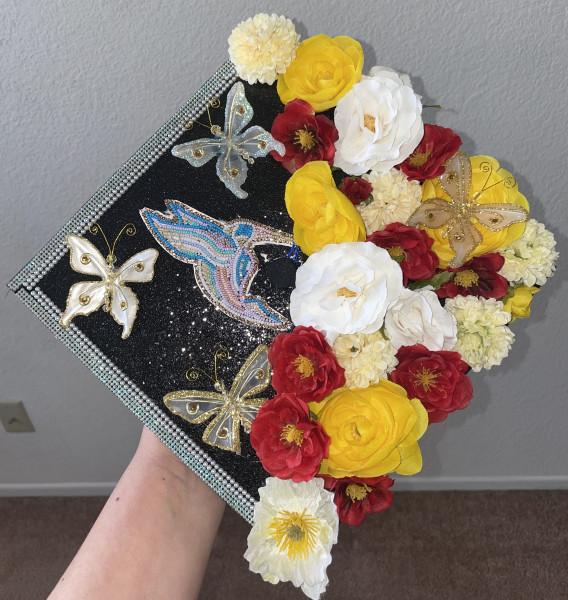
At commencement, Smith will walk across the stage to accept her bachelor’s degree in social sciences, proudly representing her Indigenous heritage by donning a hand-beaded hummingbird on her cap.
“Hummingbirds represent healing and transformation,” she said. “I feel like I really resonate with that.”
At CSUSM, Smith has gained much more than just a degree. She found a home that helped her heal and transform into a proud biracial woman who’s ready to spread her wings.
Media Contact
Eric Breier, Interim Assistant Director of Editorial and External Affairs
ebreier@csusm.edu | Office: 760-750-7314