


Alumnus Returns to Nest as Head of New American Indian Student Center
By Brian Hiro
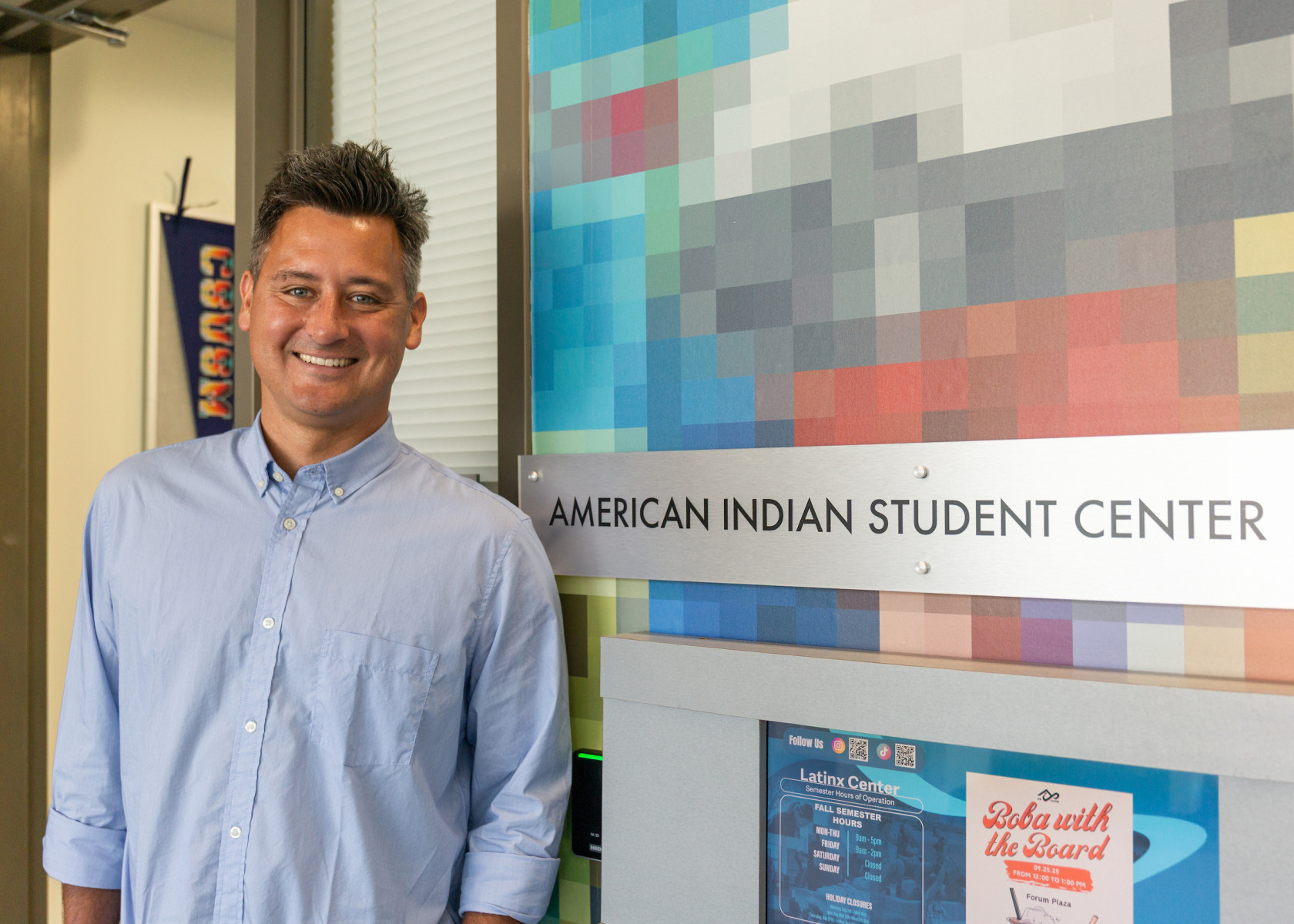
Joely Proudfit arrived as a professor at Cal State San Marcos in 2008 – before she became chair of an American Indian studies department that then didn’t exist, before she founded an on-campus center devoted to California Indian culture and sovereignty.
That fall, Proudfit taught a course called “Native American Communities.” It was a small class, featuring only about a dozen students. One of them stood out immediately.
Proudfit had known the family of Tommy Devers for years. They are both Luiseño Indians, and Tommy’s uncle is Chris Devers, the former chairman of the Pauma Band of Luiseño Indians, who has deep ties to CSUSM. But that didn’t prepare her for what she would encounter in Tommy.
“I noticed his commitment and curiosity right away, but what struck me more deeply was the way he carried himself in service to his community,” Proudfit said. “His hands were always in the work. He showed up for his people with a sincerity that you cannot teach.
“There is simply a light to him. My husband used to joke that Tommy should be the mayor of whatever town he happened to live in because he is just that kind of person: engaged, grounded, generous and easy to gravitate toward.”
After graduating from CSUSM with a degree in communication in 2009, Devers went on to complete a master’s program in sociological practice, bolstering his connection to the university. During that time, he further immersed himself in Native studies, and even helped Proudfit move into the new California Indian Culture and Sovereignty Center (CICSC).
About a year ago, then, when a job as the first leader of a planned American Indian Student Center became available, Proudfit had the ideal candidate in mind.
“Tommy,” she said, “was exactly the person we needed.”
And Devers was exactly the person CSUSM got. Hired as assistant director in February, the double alumnus spent his first semester observing and developing relationships with American Indian and other students while working out of an office near Proudfit in the CICSC. By late August, he had moved into his new office in the student center, which occupies a suite in the University Student Union that formerly housed the Cross-Cultural Center.
This fall, he has overseen five student employees while the American Indian Student Center welcomes in an average of about 20 students per day. Greeting them as they enter is an enormous, wall-sized mural painted by American Indian studies professor Eric Tippeconnic. To make the center more inviting, Devers and his team rebranded it as “The Nest,” both a nod to the center's logo of a feather and a nickname that rolls off the tongue more easily.

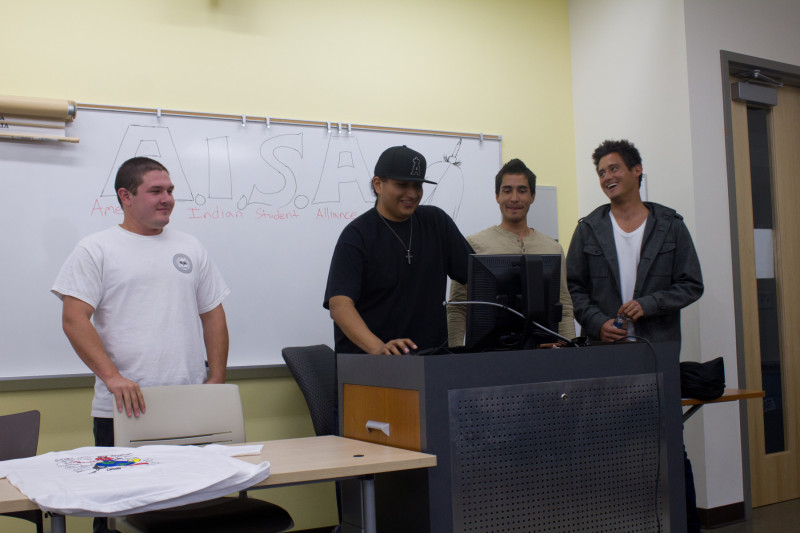
“This is going to become the nest where students come, they get nurtured, they grow and then they move on in their journey,” Devers said. “So it took on a more symbolic meaning as well.
“There's a lot of excitement from the students, and I think they have a strong desire to make this space their own. This is the foundational year. This is when we start being mindful of how we want the center to be, the legacy we want it to have.”
The Nest represents the fulfillment of a desire Proudfit has held almost from the day she first stepped foot on campus to give CSUSM’s American Indian students a place they could call their own. Out of necessity, they have congregated over the years at the CICSC on the first floor of the Social and Behavioral Sciences Building.
A door opened a couple of years ago when Viridiana Diaz, CSUSM’s vice president for Student Affairs, formed an advisory committee led by lecturer John Tippeconnic, whose report affirmed the need for a dedicated center. The timing lined up perfectly with the availability of Devers, who had moved back to California after some time living out of state and was ready to return to higher education.
“He was raised for this kind of work,” Proudfit said. “He is thriving because the job aligns with his spirit, his community roots and his lived commitment to our students.”
Devers grew up on the Pauma reservation as the youngest of four children of a Luiseño father and Irish mother. He recalls an idyllic childhood marked not only by normal pursuits such as abundant outdoor play in the rural landscape but also by a stint as an actor.
As a fifth-grader, he attended a casting call, which led a trip to acting school, the hiring of an agent and, on his seventh audition, a role in the TV show “Power Rangers.” During middle school, he even moved to Los Angeles for a year with his mom to try acting full-time before concluding that the world of Hollywood was not for him.
The sense of adolescent adventure, however, didn’t come without some discomfort related to his identity.
“There's definitely some pain that came up because my mom is white and my dad is Indian,” Devers said. “Being half-white on the reservation, you're very aware of your situation at a young age.”
After being part of one of the first graduating classes at Valley Center High School, Devers went to Palomar College along with his brother and one of his two sisters. It was a rather aimless period for him. He explored being a photography major. He contemplated becoming an English teacher. He took a semester off to travel, and ultimately stayed at the college for almost four years.
“No one who I knew could explain to me what the next steps were,” he said.
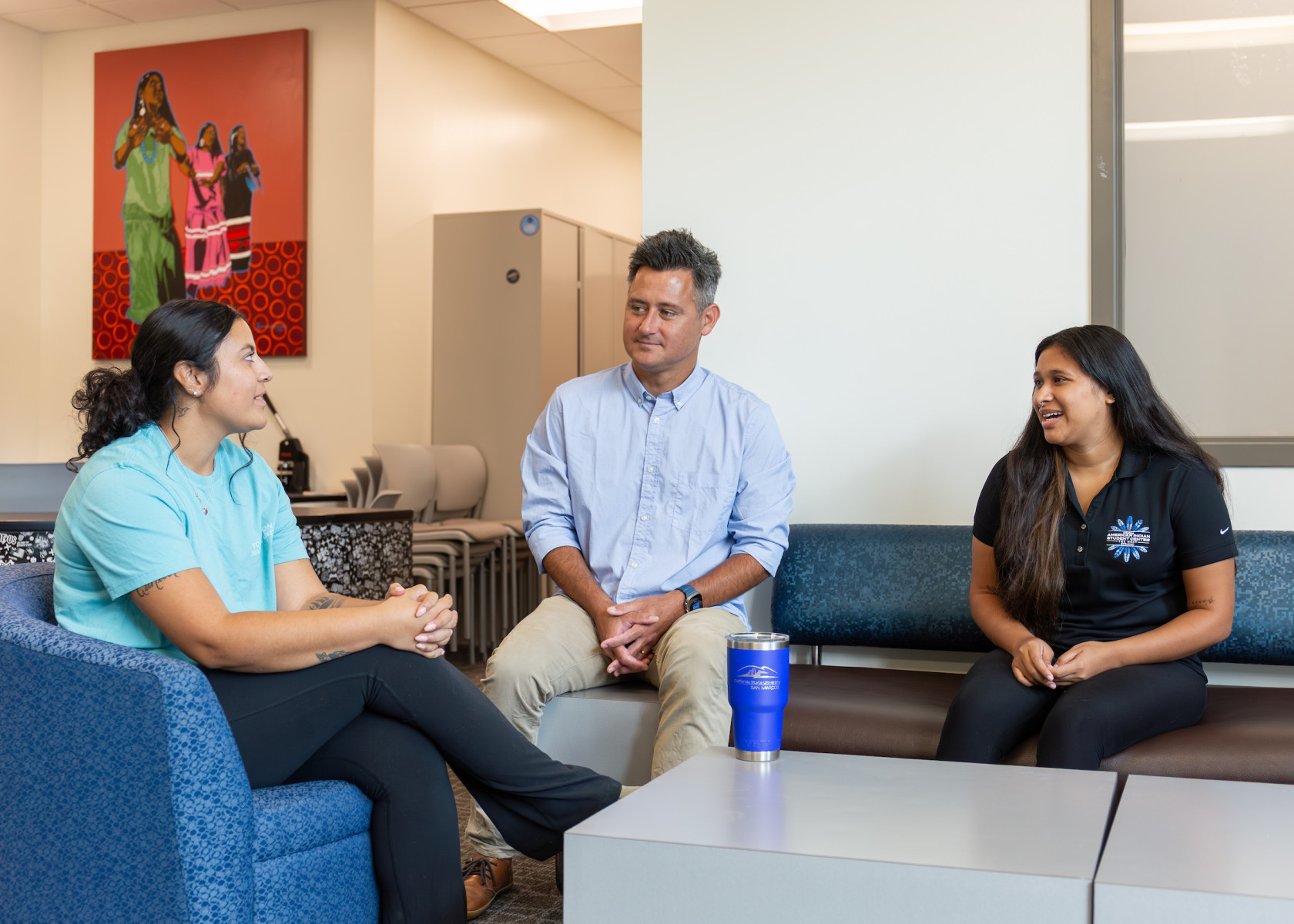
Devers found direction when he transferred to CSUSM in 2007, and particularly the following year when Proudfit joined the faculty. The American Indian studies discipline hadn’t been created yet, but he took as many classes in that vein as he could. After he earned his bachelor’s degree, Proudfit helped him land a job with the U.S. Census Bureau, for which he leveraged his tribal relationships and cultural knowledge to help boost participation by Native peoples in the 2010 census.
The more Devers went down the path of connecting with his heritage, the farther he wanted to go. He began working for his tribe as a youth program coordinator. He came back to CSUSM to earn a master’s and resumed his leadership in the American Indian Student Alliance.
“I realized that education was changing my life in a way I never imagined,” Devers said. “The subjects I was learning about were changing the way I thought about things and approached ideas.”
Devers was in his second year of the master’s program when the CICSC opened in 2011. Proudfit remembers that it was Nov. 17, the same day she returned from maternity leave. While she was holding her 3-month-old daughter, Piper, Devers and an interior designer friend of Proudfit’s decorated the center in one day on a shoestring budget.
“We filled the space with photos of our students and tribal community members, and much of what they created that day still lives in the center now,” Proudfit said. “Tommy has been integral to the CICSC from day one. His labor, his vision, his spirit are all woven into the roots of that space, and I remain deeply grateful.”
Fourteen years later, now married with two young children, Devers is integral to a new space for American Indian students. Following a first year in the job aimed at establishing The Nest and making students feel at home, he plans to turn his focus to career pipelines and recruitment.
To that end, he’s the lead organizer for the 2026 edition of Dream the Impossible, a Native youth conference that has been held for nearly two decades and is returning to CSUSM in April. More than 500 Native middle and high school students will converge on campus for an event that will introduce them to Native professionals in various fields and tout the transformative power of higher education.
Devers knows a thing or two about that.
“I have such hope for what this university is becoming,” he said. “The knowledge and kinship that can be gained through American Indian studies, the CICSC, the American Indian Student Alliance and The Nest can have a massive impact in tribal communities. That's what excites me the most. We're developing students who will lead our tribal communities into a future rooted in sovereignty, accountability and cultural strength."
Media Contact
Brian Hiro, Communications Specialist
bhiro@csusm.edu | Office: 760-750-7306